
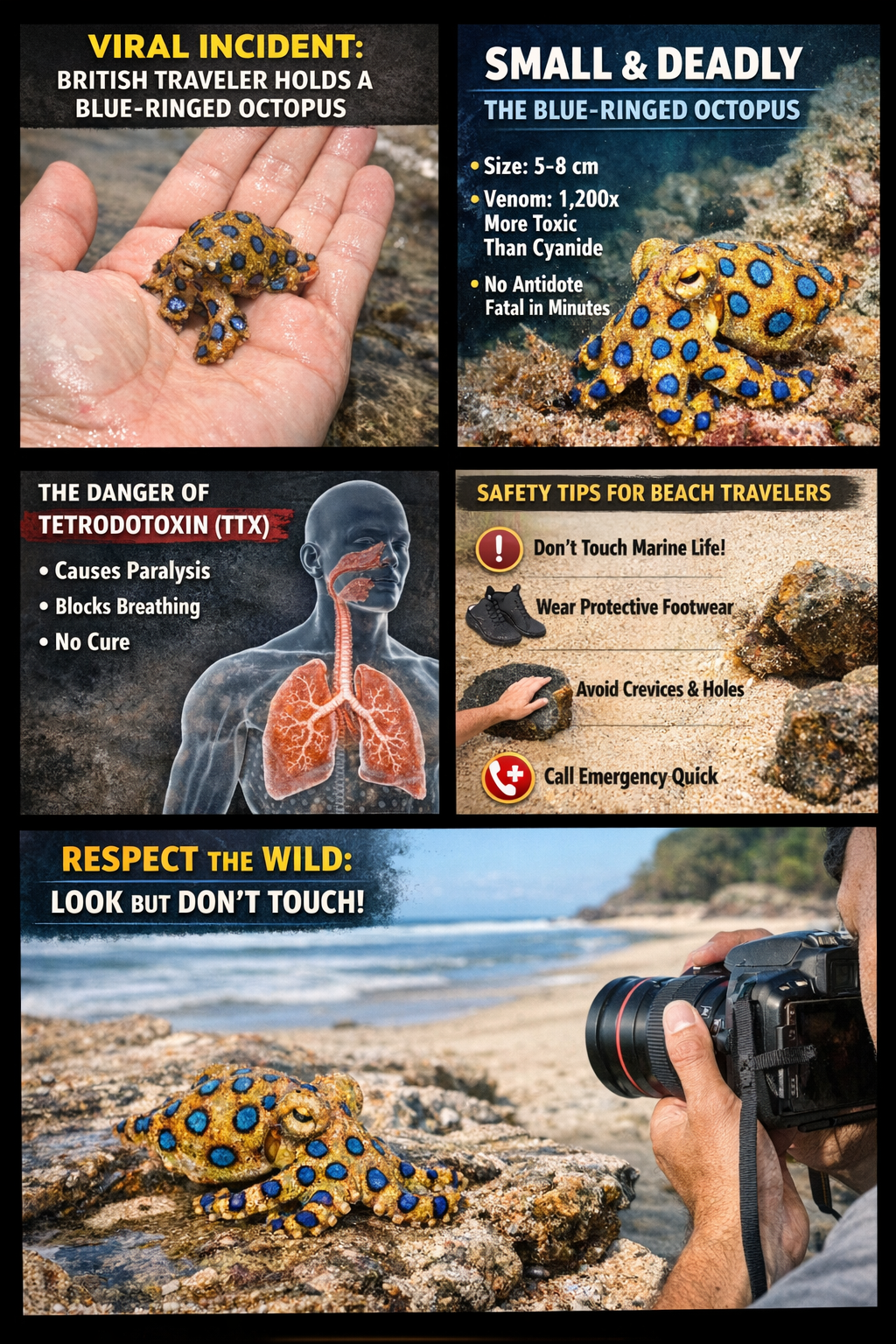
In the age of social media, we are often driven by the desire to capture the perfect shot. We see a vibrant creature in a tide pool or a unique shell on the sand, and our first instinct is to reach for our phones—or worse, reach out with our hands.
Recently, a British tourist’s holiday video went viral for all the wrong reasons. What started as a fascinating discovery on a sun-drenched beach nearly ended in a fatal tragedy. The subject of the video? A tiny, glowing, blue-ringed octopus.
To the untrained eye, it looks like a toy. To a marine biologist, it is one of the most efficient killing machines on the planet. This incident serves as a harrowing case study in travel safety and the “look but don’t touch” rule of the wild.
1. The Incident: A Viral Moment That Could Have Been Fatal
The footage, which has since circulated across TikTok and Instagram, shows a small, yellowish octopus crawling across a person’s hand. As it moves, brilliant, iridescent blue rings pulse across its skin. It looks ethereal, almost magical.
The traveler, unaware of the stakes, filmed the encounter to share the beauty of the local wildlife with friends back home. It wasn’t until the video was posted online that the comments section exploded with panic. Local residents and wildlife experts quickly pointed out that the traveler was holding enough venom to kill 26 adult humans in under half an hour.
Why was it so dangerous?
The blue-ringed octopus (Hapalochlaena) is famously docile. It doesn’t hunt humans. However, when handled or stepped on, it bites. The bite itself is often painless—many victims don’t even realize they’ve been envenomated until the respiratory paralysis sets in.
2. Meet the Assassin: What is a Blue-Ringed Octopus?
To understand why this encounter was a “close call,” we need to look at the biology of this cephalopod. Found primarily in the Pacific and Indian Oceans, from Japan to Australia, these creatures are masters of disguise.

Appearance and Camouflage
Most of the time, the blue-ringed octopus is a dull, sandy brown or yellow color, blending perfectly with coral reefs and tide pools. It only reveals its signature electric blue rings when it feels threatened or provoked. Those rings are a “warning display” (aposematism), a biological neon sign saying, “Back off, I am toxic.”
The “Tiny” Factor
One of the reasons travelers fall into this trap is size. These octopuses are rarely larger than 12 to 20 centimeters (5 to 8 inches). Their small stature gives a false sense of security, leading people to believe they are harmless “babies” or “cute” marine life.
3. The Science of the Venom: Tetrodotoxin (TTX)
The blue-ringed octopus doesn’t just have “mild” venom; it carries Tetrodotoxin. This is the same neurotoxin found in pufferfish, but in much higher concentrations.
| Feature | Description |
| Potency | 1,200 times more toxic than cyanide. |
| Mechanism | It blocks sodium channels, stopping nerve signals to muscles. |
| Onset | Symptoms can begin within minutes. |
| Antidote | None. There is no known antitoxin for TTX. |
The most terrifying aspect of this venom is that it causes total muscular paralysis while the victim remains fully conscious. The heart continues to beat, but the muscles required to breathe stop working. Without immediate medical intervention (artificial respiration), the victim dies from asphyxiation.
4. The Psychology of the “Social Media Trap”
Why did this British traveler—and many others before them—pick up such a dangerous animal?
- The “Screen” Buffer: When we view the world through a smartphone lens, we sometimes feel a sense of detachment from reality. The desire for “content” overrides our survival instincts.
- Lack of Local Knowledge: Tourists often lack “environmental literacy.” What a local child in Australia knows to avoid at all costs, a tourist from the UK might see as a “cool find.”
- The Aesthetic Bias: We tend to associate “scary” animals with teeth, fur, or large sizes (sharks, bears). We struggle to perceive a 4-inch, colorful mollusk as a lethal threat.
5. Essential Safety Tips for Coastal Travellers
If you are headed to a tropical destination, follow these rules to ensure your holiday doesn’t turn into a medical emergency:
1. The “Golden Rule” of Marine Life
Never touch what you cannot identify. Even if you think you know what it is, observe from a distance. Many venomous creatures, like the stonefish or cone snail, look like harmless rocks or shells.
2. Wear Protective Footwear
When exploring tide pools or walking on reefs, wear sturdy water shoes. Blue-ringed octopuses often hide in empty shells or crevices. Stepping on one is a common way people get bitten.
3. Don’t Put Your Hands in Crevices
If you’re snorkeling or diving, avoid sticking your hands into dark holes or under rocks. This is the preferred habitat for octopuses and eels.
4. Research Your Destination
Before you go, spend ten minutes Googling “Dangerous wildlife in [Location].” Knowing what to look for can save your life.
6. What to Do in an Emergency
If someone is bitten by a blue-ringed octopus, every second counts. Because there is no antivenom, the treatment is supportive care.
- Call Emergency Services Immediately: Tell them specifically that you suspect a blue-ringed octopus bite.
- Pressure Immobilization: Apply a broad pressure bandage (like for a snake bite) over the bite site and along the limb to slow the spread of venom.
- Artificial Respiration (CPR): This is the most critical step. If the victim stops breathing, you must perform rescue breathing or use a manual resuscitator until they reach a hospital and can be placed on a ventilator.
- Stay with Them: If the victim is paralyzed, they can still hear you. Keep them calm and continue breathing for them until help arrives.
Conclusion: Respect the Wild
The British traveler in the viral video was incredibly lucky. The octopus chose not to bite, despite being handled. It was a moment of grace from nature that could have easily been a tragedy.
Nature isn’t a theme park; it’s a complex ecosystem where many inhabitants have evolved sophisticated ways to defend themselves. As travelers, it is our responsibility to be guests in these environments—observing with our eyes, capturing with our cameras, but always keeping our hands to ourselves.
The next time you see something beautiful and mysterious on a beach, remember the blue-ringed octopus. Some of the most stunning sights in nature are best enjoyed from a safe distance.

