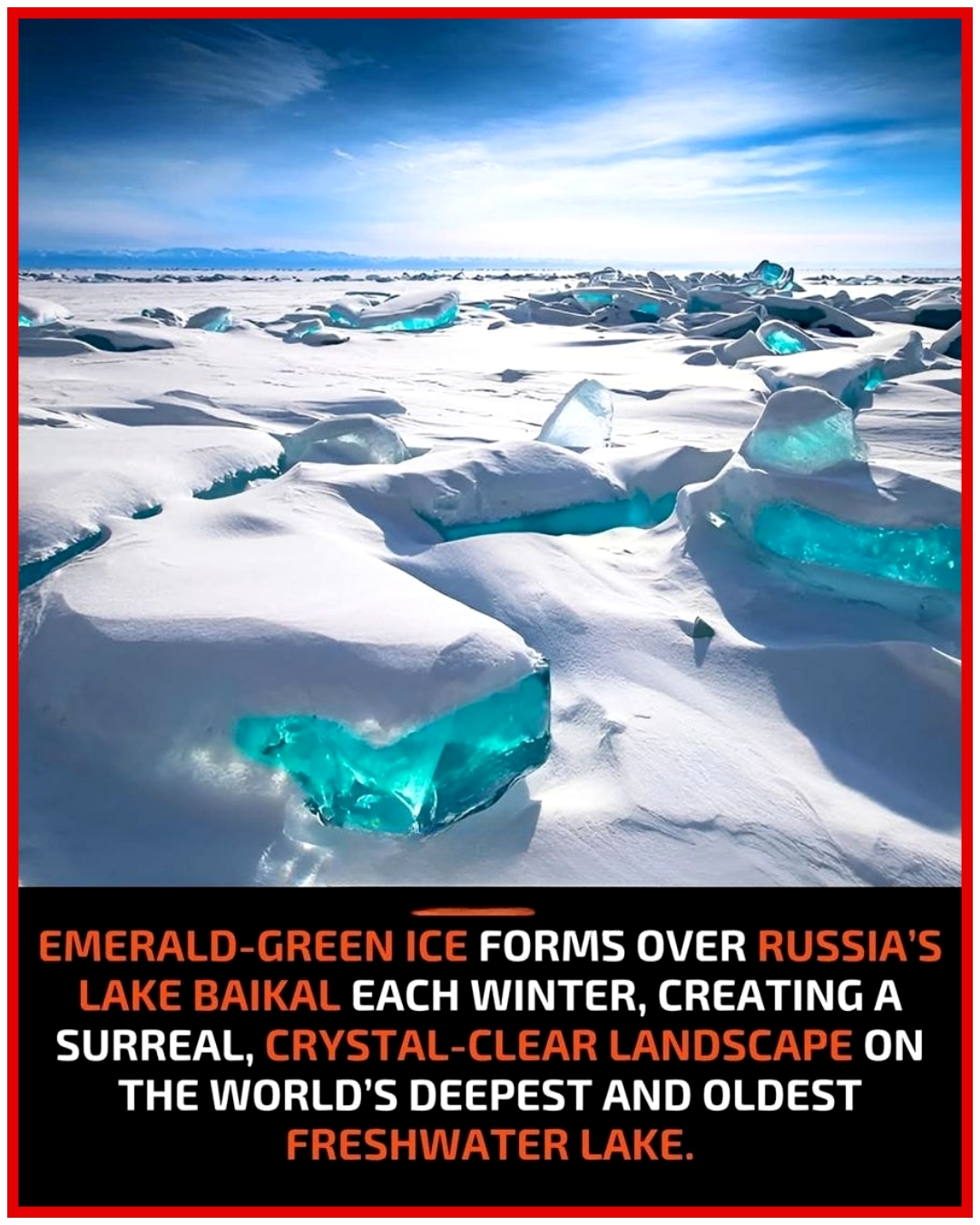

Every winter, a breathtaking transformation unfolds in the heart of Siberia. As temperatures plummet to bone-chilling lows, Lake Baikal, the world’s oldest and deepest freshwater lake, dons a new identity — one of striking beauty and surreal elegance. Its surface turns into emerald and turquoise ice, a phenomenon so rare and mesmerizing that it attracts photographers, scientists, and adventurers from across the globe.
This isn’t just a frozen lake. This is nature’s artwork, a place where physics, purity, and winter magic collide to create a living crystal canvas like no other on Earth.
A Lake Like No Other
Before diving into its winter transformation, it’s important to understand why Lake Baikal is so special.
Located in southern Siberia, Lake Baikal is estimated to be around 25 million years old, making it the oldest lake on Earth. It also holds the title of the deepest, plunging to depths of over 1,642 meters (5,387 feet). With more than 20% of the world’s unfrozen freshwater, Baikal is not only vast in size but also unmatched in ecological significance.
Baikal is home to more than 3,700 plant and animal species, many of which are found nowhere else. Its waters are crystal-clear year-round, thanks to the unique combination of endemic microorganisms and low pollution levels — and it is precisely this purity that gives rise to its iconic winter phenomenon.
The Science Behind the Emerald Ice
When winter arrives, Siberia’s freezing temperatures — sometimes dropping below -30°C (-22°F) — cause the lake to freeze over. But unlike other frozen lakes, the ice on Lake Baikal takes on a translucent emerald or turquoise hue.
Here’s how this happens:
- Exceptionally pure water: Lake Baikal’s water is incredibly clean and rich in oxygen, allowing light to penetrate deeply before scattering.
- Sunlight and angle of light: In winter, sunlight reflects at low angles across the ice, enhancing the blue-green spectrum of refracted light.
- Lack of impurities: With minimal sediments or pollutants, there’s nothing to distort the clarity or coloration of the ice.
- Ice thickness: As the ice builds up to 1–2 meters thick, it begins to act like glass, amplifying color and light patterns beneath the surface.
What results is a stunning spectrum of green and blue, often punctuated by jagged cracks, frozen methane bubbles, and mirror-like reflections of the sky and surrounding snow-covered mountains.
A Natural Playground for Adventurers
Once frozen, Lake Baikal becomes a playground for the bold and curious. From January through March, the surface is solid enough to support vehicles, hikers, ice skaters, and even cyclists.
Here are some of the most popular winter activities:
- ❄️ Ice Trekking: Adventurers walk across the transparent ice, marveling at the lakebed visible beneath their feet.
- 🚴♂️ Ice Biking: Cyclists travel dozens or even hundreds of kilometers across the lake.
- 🛷 Dog Sledding and Ice Camping: For the truly adventurous, there are tours that offer overnight camping on the ice — under the stars and atop the world’s oldest lake.
- 📸 Photography Expeditions: Capturing the emerald ice, frozen bubbles, and shimmering cracks has become a rite of passage for landscape photographers.
A Dream for Photographers
Photographers describe Lake Baikal in winter as a dreamlike environment, one that changes by the minute as sunlight, clouds, and ice features shift.
Some iconic sights include:
- 🌬️ “Dragon Ice”: Long, snaking cracks in the ice that resemble the spines of mythical creatures.
- 💎 Frozen Bubbles: Trapped methane and oxygen bubbles rise and freeze, suspended in layers like nature’s jewelry.
- 🧊 Crystal Slabs: Huge chunks of broken ice stack up along the shoreline, forming surreal geometric sculptures.
- 🌄 Sunset and Sunrise Glow: The golden and pink hues of twilight reflecting off the glassy surface is a once-in-a-lifetime sight.
Many visitors say that photographs don’t do it justice — standing on clear ice and seeing straight into the depths of Baikal is both awe-inspiring and humbling.
Climate, Culture, and Conservation
Lake Baikal is not only a natural wonder, but also a place of cultural and ecological importance. For centuries, it has been revered by indigenous communities such as the Buryats, who view the lake as sacred. In fact, its name comes from the Turkic “Bai-Kul,” meaning “Rich Lake.”
However, as beautiful as it is, Lake Baikal is vulnerable.
Climate Change Threats
With the global climate crisis, Baikal’s winter ice is forming later and melting earlier each year. This reduces the time window for the emerald ice phenomenon and impacts the lake’s delicate ecosystem.
Rising temperatures also threaten the native nerpa seals and other species unique to Baikal.
Tourism vs. Preservation
While winter tourism is booming, it brings both opportunities and challenges. Sustainable practices are needed to preserve the lake’s purity and ecosystem. Responsible travel, waste reduction, and strict environmental guidelines are essential to ensuring that future generations can also marvel at Baikal’s frozen beauty.
How to Visit Lake Baikal in Winter
If you’re planning a trip to witness the emerald ice of Lake Baikal, here are a few tips:
- 📍 Best Location: The area around Listvyanka and Olkhon Island offers some of the most photogenic ice.
- 📆 Best Time: Mid-February to early March is the ideal window — when the ice is thickest and clearest.
- 🧥 Dress Smart: Siberian winters are brutally cold. Wear insulated boots, layers, and windproof outerwear.
- 🧭 Go with a Guide: Local tours offer safe transport, storytelling, and insider access to the best photo spots.
- 🚫 Leave No Trace: Help protect the lake by minimizing waste, avoiding motorized vehicles on fragile areas, and respecting the local ecosystem.
Final Thoughts
Lake Baikal’s emerald ice is more than just a winter attraction — it’s a rare gift of nature, where science and beauty converge in a frozen masterpiece. It’s one of those places that remind us how magical and mysterious our planet still is, even in a digital, fast-moving world.
Whether you’re an adventurer, a photographer, or simply someone who appreciates the wonders of the Earth, Lake Baikal in winter deserves a place on your bucket list. Because sometimes, the most extraordinary beauty is found in the coldest corners of the world.
Have you seen Lake Baikal’s emerald ice or dream of visiting? Share your thoughts or tag someone who’d love to see this winter wonderland!
#LakeBaikal #EmeraldIce #WinterWonders #FrozenBeauty #NaturePhotography #SiberianMagic #CrystalIce #BucketListTravel #EcoTourism #FrozenLake #BaikalAdventure #NaturalWonders