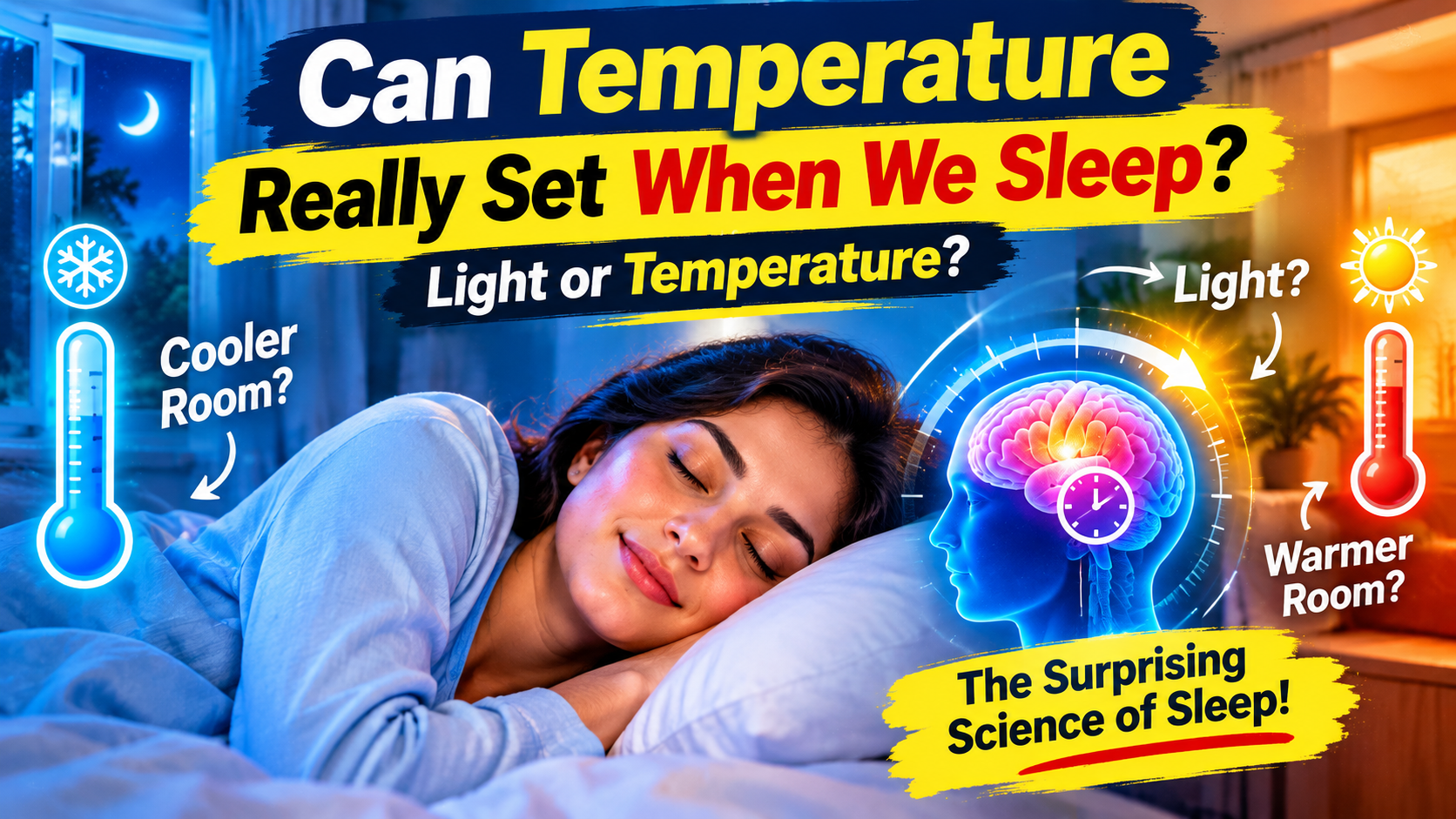
For decades, light has been considered the most important environmental signal influencing the human circadian rhythm—the internal biological system that helps determine when we feel awake and when we become sleepy.
Morning sunlight helps signal that the day has begun. Darkness in the evening encourages the body to prepare for sleep. Modern sleep advice therefore focuses heavily on light exposure, especially reducing bright and blue light before bedtime.
But there may be another environmental signal quietly influencing our sleep: temperature.
Researchers studying sleep patterns in different environments have found intriguing evidence that changes in ambient temperature may affect when people sleep and how their internal body clocks function. Some scientists have even suggested that temperature could play a role comparable to light under certain circumstances.
The idea is fascinating because our bodies naturally undergo a significant temperature change every night. As we prepare for sleep, our core body temperature begins to fall. It continues dropping during the early part of the night before reaching its lowest point and gradually rising again toward morning.
This raises an important question:
Could the temperature around us be helping our bodies know when it is time to sleep?
The answer is not yet completely understood. Research is still developing, and scientists disagree about just how powerful temperature is compared with light.
However, the evidence so far suggests that temperature deserves much more attention when we talk about healthy sleep.

The Natural Connection Between Temperature and Sleep
Many people instinctively prefer a cooler bedroom at night.
You may have noticed that it is easier to fall asleep after entering a cool room, while a hot and stuffy bedroom can leave you tossing and turning.
This is not simply a matter of comfort.
Our bodies are biologically programmed to experience a decline in core temperature as we approach sleep.
During the day, core body temperature is generally higher. As evening approaches, the body begins preparing for rest. Blood vessels near the skin can widen, allowing heat to escape from the body. As heat is released, core temperature gradually falls.
This process is closely associated with sleep.
For most people, core body temperature can fall by approximately 1°C from its daytime high to its nighttime low.
That change may seem small, but temperature regulation is deeply connected to the mechanisms that control sleep.
When the environment is excessively warm, the body can have more difficulty releasing heat. As a result, falling asleep may take longer and sleep may become more fragmented.
This is one reason why sleeping in a room that is too hot can feel uncomfortable even when you are physically exhausted.
A Childhood Habit That Raised an Interesting Question
Anthropologist Gandhi Yetish has described remembering a simple bedtime habit from his childhood.
During cold winters in New Jersey, he would sometimes open his bedroom window before going to sleep. Cold air would enter the room, cooling his face and making him feel increasingly sleepy.
At the time, he considered it little more than a personal preference.
Later, while studying sleep patterns among people living in non-industrial environments, he began to wonder whether there was something more fundamental behind that experience.
His research brought him into contact with the Tsimane, an Indigenous population living in Bolivia.
Their lifestyle provided researchers with a unique opportunity to study sleep in an environment without many of the artificial conditions that characterize modern life.
The Tsimane spend significant amounts of time outdoors and have limited exposure to artificial lighting compared with people living in industrialized societies.
Yet their sleeping patterns did not simply follow sunset and sunrise.
This observation led researchers to consider another environmental factor that changes naturally throughout the day:
temperature.
What Indigenous Sleep Patterns Can Teach Us
Researchers later studied sleep patterns among other Indigenous groups, including the Hadza of northern Tanzania and the San of Southern Africa.
An interesting pattern emerged.
Their sleep timing did not appear to correspond perfectly with the changing levels of natural light.
Instead, researchers observed that sleep timing seemed to be closely associated with the natural rise and fall of environmental temperature.
This finding does not prove that temperature controls sleep.
There are many differences between modern industrial societies and traditional communities. These include physical activity, diet, daily routines, social schedules, stress levels, exposure to artificial light, and access to electricity.
Nevertheless, the observation raised an important scientific question.
If sunlight influences temperature as well as light levels, perhaps temperature is another environmental signal that the human body has evolved to recognize.
As Yetish has suggested, we often assume that sunset and sunrise matter because of changes in light.
But the Sun influences the environment in more than one way.
It also drives changes in temperature.
Why a Cooler Body Helps Prepare Us for Sleep
The relationship between temperature and sleep becomes clearer when we examine what happens inside the body before bedtime.
As evening approaches, the body begins a process known as thermoregulatory heat loss.
Blood vessels in the skin can expand, especially around the hands and feet. This allows more heat to move from the body’s core toward the skin and eventually into the surrounding environment.
This heat-loss process contributes to the decline in core body temperature associated with sleep.
At the same time, the hormone melatonin begins increasing.
Melatonin is produced naturally by the body and plays an important role in regulating the sleep-wake cycle. Its production is influenced strongly by the body’s circadian system and exposure to light.
As melatonin rises, the body begins transitioning toward a state that is more compatible with sleep.
Temperature and melatonin therefore appear to be connected through a larger network of biological processes.
This does not mean that simply lowering the temperature of a room will automatically make someone sleepy.
Rather, the environment can potentially support the physiological changes that naturally occur as the body prepares for sleep.
What Happens When Your Bedroom Is Too Warm?
Most people have experienced the frustration of trying to sleep during a hot night.
You may feel restless, sweat, repeatedly change sleeping positions, or wake up several times.
Excessive warmth can interfere with the body’s ability to lose heat.
Instead of smoothly moving toward its natural nighttime temperature, the body may struggle to cool itself.
This can affect several aspects of sleep.
You may have:
- More difficulty falling asleep
- More frequent awakenings
- Less comfortable sleep
- Increased restlessness
- Reduced sleep quality
- Greater tiredness the following morning
A warm bedroom does not affect everyone equally.
Age, health, clothing, bedding, humidity, physical activity, and individual differences all influence how people respond to temperature.
Humidity is especially important because high humidity can make it harder for sweat to evaporate from the skin. As a result, the body may struggle even more to release heat.
This explains why a moderately warm room can sometimes feel much hotter when humidity is high.
The Interesting Role of Temperature Fluctuations
One of the most fascinating areas of research involves changing temperatures rather than simply maintaining a cool room.
In one study, researchers compared different bedroom temperature conditions.
In one setting, the room temperature gradually decreased during the evening, remained lower during the early part of the night, and then increased toward morning.
The pattern was designed to imitate the natural temperature cycle that occurs around dusk, nighttime, and dawn.
In another condition, the room remained at a relatively constant temperature.
The results were interesting.
Participants exposed to the fluctuating temperature pattern showed higher levels of a marker associated with nighttime melatonin production compared with participants who slept under a constant temperature.
They also reported feeling more refreshed when they woke.
The researchers proposed that natural temperature fluctuations may be part of the environmental conditions under which human sleep evolved.
If that is true, our modern habit of maintaining nearly identical indoor temperatures throughout the entire day and night could be different from the environment our biological systems originally adapted to.
However, it is important to remember that this was not proof that everyone needs a dramatic temperature change at night.
The ideal temperature pattern remains uncertain.
Could Temperature Influence the Circadian Clock?
This is where the science becomes particularly interesting.
Sleep is controlled by multiple biological systems.
One of the most important is the circadian rhythm.
Your circadian system operates roughly on a 24-hour cycle and influences numerous biological functions, including:
- Sleep and wakefulness
- Hormone production
- Body temperature
- Appetite
- Digestion
- Alertness
- Metabolism
- Physical performance
For many years, scientists have emphasized light as the dominant environmental signal that synchronizes this internal clock.
Light entering the eyes sends information to the brain’s circadian system, helping synchronize the body’s timing with the external day-night cycle.
But temperature may also provide information.
The question is not whether temperature affects sleep—it clearly can.
The more difficult question is:
Can environmental temperature actually reset or synchronize the human circadian clock?
Scientists do not yet have a definitive answer.
Evidence From Animals
Some evidence comes from animal research.
Scientists have discovered that temperature cycles can influence circadian rhythms in a variety of species.
Research involving animals such as fruit flies and camels has demonstrated that changing temperature patterns can help synchronize their internal biological clocks.
These experiments are valuable because they show that biological systems can respond to temperature as a timing signal.
But there is an important limitation.
Humans are not fruit flies, camels, or laboratory animals.
A mechanism that works in one species does not automatically operate in exactly the same way in humans.
Nevertheless, animal research provides an important clue: biological clocks may be capable of responding to environmental temperature changes.
What About Human Cells?
Scientists have also explored temperature effects at the cellular level.
In laboratory experiments, researchers have been able to influence the internal clocks of human cells by simulating fluctuations in body temperature.
This is an intriguing finding.
It suggests that temperature-sensitive mechanisms may exist within human biological systems.
However, studying isolated cells is very different from studying a complete human being.
Real people are exposed to light, food, physical activity, stress, social schedules, hormones, and countless other environmental influences.
Therefore, laboratory findings involving cells cannot by themselves establish that changing bedroom temperature will reset a person’s circadian rhythm.
They simply add another piece to the scientific puzzle.
An Early Human Experiment
Some older human research also provides interesting clues.
In one study, participants adjusted their sleeping environment so that the temperature was significantly cooler while they were sleeping than when they were awake.
Researchers observed changes in the timing of the participants’ sleep-wake cycles.
The effect was relatively small, but it was notable because the researchers suggested that temperature could influence the human circadian system in a way that was somewhat comparable to the effects of light.
This finding remains interesting because it challenges the idea that light is the only environmental factor capable of influencing circadian timing.
However, older studies often involved small numbers of participants, and modern researchers emphasize the need for larger and better-controlled experiments.
A 2007 Study Offers Another Clue
Another study conducted in 2007 investigated what happened when bedroom temperatures followed a natural-looking cycle.
Participants experienced a gradual decrease in temperature during the evening followed by an increase toward morning.
The researchers observed changes in the participants’ internal body temperature.
Importantly, the timing of the lowest point of body temperature shifted earlier during the night when the participants were exposed to the fluctuating temperature pattern.
Why is that important?
The timing of the body’s lowest temperature is often used as an indicator of circadian phase.
In simple terms, it provides scientists with information about where a person is within their internal biological cycle.
The observation therefore suggested that environmental temperature may influence more than comfort.
It might also affect the timing of the body’s internal clock.
Still, this evidence is not strong enough to conclude that temperature is as powerful as light.
Temperature Is Not the “New Light”
Some scientists are enthusiastic about the potential importance of temperature.
Others are more cautious.
Christian Cajochen, a chronobiologist at the University of Basel, has suggested that temperature may help modulate circadian rhythms.
However, he has also emphasized that relatively few experiments have directly investigated this question.
For that reason, temperature should not currently be considered a replacement for light.
Light remains the strongest and best-established environmental signal for regulating human circadian timing.
Morning daylight, in particular, plays an important role in synchronizing the internal clock.
Temperature may be another signal working alongside light rather than replacing it.
The body does not operate through a single environmental switch.
Instead, it integrates information from multiple sources.
Sleep Is More Complicated Than One Biological Clock
Another reason this research is difficult is that sleep itself is controlled by several interacting systems.
Scientists generally describe at least two major processes.
The first is the sleep homeostat.
Think of this as sleep pressure.
The longer you remain awake, the more sleep pressure builds.
After sleeping, that pressure decreases.
The second major system is the circadian rhythm.
This system determines when your body is naturally more inclined to feel sleepy or alert.
Together, these two systems help determine when you sleep and when you wake.
But there is another important factor:
the arousal system.
This system helps keep the brain alert when necessary.
For example, imagine waking suddenly at 3 a.m. because a fire alarm begins ringing.
Your sleep pressure may be extremely high, and your circadian system may be encouraging sleep.
Yet the alarm can immediately wake you.
That happens because the brain’s arousal mechanisms can temporarily override sleep-promoting processes.
Temperature interacts with this complicated network.
This makes it difficult for researchers to determine exactly how much of its effect comes from the circadian clock and how much comes from simple physiological comfort.
Does a Hot Room Change Your Circadian Rhythm or Just Your Sleep?
This is one of the biggest unanswered questions.
Suppose you sleep badly in a very hot bedroom.
Does that mean your circadian clock has shifted?
Not necessarily.
The heat may simply make it harder for your body to enter or maintain comfortable sleep.
This distinction is extremely important.
A person could experience poor sleep because their body cannot release enough heat, without experiencing any meaningful change in their circadian rhythm.
Therefore, researchers need carefully designed experiments that separate:
sleep quality
from
circadian timing.
That is much harder than simply asking people whether they slept well.
What Traditional Lifestyles Can Tell Us
The research involving Indigenous communities has attracted attention because it provides a window into sleep under very different environmental conditions.
Modern life has transformed the environment in which humans sleep.
Many people spend most of their days indoors.
We use artificial lighting after sunset.
We work on computers and smartphones late into the evening.
We maintain homes at relatively stable temperatures.
We can eat at almost any hour.
We can remain physically active or mentally stimulated long after sunset.
All of these factors can potentially influence sleep.
In contrast, people living in traditional environments may experience stronger natural changes in light and temperature throughout the day.
Their daily routines may also be more closely connected to environmental conditions.
This does not mean traditional lifestyles are automatically healthier in every respect.
It does, however, provide scientists with valuable opportunities to study how human sleep behaves under different environmental conditions.
Why Modern Indoor Temperatures May Matter
Modern heating and air-conditioning systems provide enormous benefits.
They protect people from extreme heat and cold and make indoor environments comfortable.
But there may be an unintended consequence.
Indoor temperatures can remain remarkably stable.
A modern bedroom might be almost the same temperature at midnight as it was at 6 p.m.
Natural outdoor environments are different.
Temperatures generally change throughout the day.
Even after sunset, the environment may continue cooling for several hours before beginning to warm again toward morning.
If temperature is one of the environmental signals our bodies evolved to recognize, a completely stable indoor environment may provide less information about the time of day.
This is an interesting hypothesis, but it remains a hypothesis.
More research is necessary before scientists can determine whether deliberately recreating natural temperature cycles provides meaningful health benefits.
Could Opening a Window Help You Sleep?
For some people, a cooler bedroom can make falling asleep easier.
Opening a window may provide a simple way to allow cooler outdoor air into the room.
However, this is not appropriate everywhere.
Outdoor temperatures may be extremely hot, cold, humid, or polluted.
Noise can also interfere with sleep.
People living in areas with high outdoor pollution should be especially cautious about leaving windows open.
The goal is not to make the bedroom freezing.
The goal is to create a comfortable sleeping environment that allows the body to regulate its temperature naturally.
A practical approach is to pay attention to your own sleep.
If you consistently feel overheated at night, improving ventilation or slightly lowering the bedroom temperature may be worth trying.
What Is the Ideal Bedroom Temperature?
There is no single temperature that is perfect for every person.
Individual preferences vary considerably.
Age, clothing, bedding, body composition, hormones, activity levels, health conditions, humidity, and personal adaptation all affect thermal comfort.
Instead of focusing obsessively on one exact number, it is generally more useful to think about the overall environment.
Your bedroom should feel comfortably cool rather than hot and stuffy.
Light bedding can help.
Breathable sleepwear can help.
Good ventilation can help.
A fan may improve air movement and make the environment feel more comfortable.
Air conditioning can also help in very hot climates.
The most important principle is simple:
Avoid an environment that makes it difficult for your body to release heat.
What Happens During the Morning?
Temperature is not only relevant when we fall asleep.
Our body temperature also begins rising as we approach wakefulness.
This creates an interesting natural cycle.
In the evening:
Body temperature falls → the body prepares for sleep.
During the night:
Body temperature remains relatively low → sleep continues.
Toward morning:
Body temperature rises → the body prepares for wakefulness.
This pattern is coordinated with other physiological changes.
Hormones change.
Metabolism changes.
Alertness changes.
Heart rate and other biological functions also shift.
Temperature is therefore part of a much larger biological rhythm.
Why Light Still Matters So Much
Even if temperature proves to be an important circadian signal, light remains central to sleep science.
The human circadian system is extremely sensitive to light, particularly at certain times of the day.
Bright light in the morning can help reinforce the body’s daytime signal.
Strong light exposure late at night can potentially delay the biological timing of sleep.
This is one reason sleep experts often recommend reducing bright light exposure before bedtime and getting natural daylight during the morning.
Temperature should therefore be viewed as a possible additional signal rather than a substitute for healthy light exposure.
A bedroom that is perfectly cool but filled with bright light at midnight is unlikely to provide an ideal sleep environment.
Could Natural Temperature Cycles Improve Sleep?
This is one of the most exciting questions for future research.
Imagine a smart home system that gradually changes bedroom temperature throughout the night.
Instead of keeping the room at exactly the same temperature, the system could create a gentle cooling period after bedtime and a gradual warming period before waking.
Such systems could potentially imitate natural environmental cycles.
Some sleep technologies are already exploring temperature-based approaches, including cooling mattresses, temperature-controlled bedding, and wearable devices that influence heat loss.
However, more independent research is needed to determine which approaches actually improve sleep and which are simply comfortable gadgets.
The scientific challenge is not just proving that temperature affects sleep.
Researchers need to determine:
- How much temperature change is beneficial?
- At what time should it occur?
- How long should the change last?
- Does it affect sleep quality or the circadian clock?
- Does it work equally well for everyone?
- Does it have long-term health benefits?
These questions remain open.
The Evolutionary Perspective
One possible explanation for the relationship between temperature and sleep comes from human evolution.
For most of human history, people did not sleep inside temperature-controlled buildings.
Their environments naturally became cooler after sunset.
People would experience changing temperatures throughout the night and warming conditions around sunrise.
Our biological systems evolved within those environments.
Modern technology has dramatically changed that situation.
We can keep our bedrooms warm during winter and cool during summer.
We can block sunlight with curtains and remain exposed to artificial lighting late into the night.
We can create indoor environments that are almost completely disconnected from outdoor environmental cycles.
From an evolutionary perspective, this raises an interesting possibility.
Perhaps some modern sleep problems are partly related to the mismatch between our biology and our highly controlled indoor environments.
But again, this remains an area of investigation rather than a proven explanation for insomnia.
Temperature and Modern Insomnia
Insomnia is common in industrialized societies.
Researchers studying Indigenous populations have reported striking differences in sleep complaints compared with modern urban populations.
Some traditional communities studied by researchers did not even have a direct word corresponding to the modern concept of chronic insomnia.
This observation has been used to support the idea that modern environments may contribute to sleep problems.
However, insomnia is complex.
It can be influenced by:
- Stress
- Anxiety
- Depression
- Work schedules
- Shift work
- Medical conditions
- Medications
- Caffeine
- Alcohol
- Noise
- Light exposure
- Physical activity
- Social pressures
- Irregular sleep schedules
- Environmental temperature
Temperature is therefore unlikely to be the only explanation.
Still, it may be one overlooked piece of the puzzle.
Simple Ways to Create a Better Sleep Environment
You do not need expensive technology to experiment with temperature and sleep.
A few simple changes may help.
1. Keep the bedroom comfortably cool
If you regularly wake up feeling hot or sweaty, your room may be too warm.
Try slightly lowering the temperature and see whether your sleep improves.
2. Improve ventilation
Fresh air and air movement can make a room feel more comfortable.
A fan can help circulate air, although it should not be directed uncomfortably toward you.
3. Choose breathable bedding
Heavy blankets and poorly breathable fabrics can trap heat.
Lightweight, breathable materials may improve comfort.
4. Wear comfortable sleepwear
Loose and breathable clothing can help the body release excess heat.
5. Avoid overheating before bed
A very hot environment immediately before bedtime may make it harder for the body to transition into sleep.
6. Consider your local climate
The ideal strategy in a cool climate may be completely different from the best approach in a hot and humid region.
7. Pay attention to your own response
Sleep is highly individual.
If a slightly cooler room helps you fall asleep faster and wake up feeling refreshed, that is useful information.
Don’t Chase Extreme Cold
The research does not suggest that colder is always better.
Making your bedroom extremely cold can also be uncomfortable and may disrupt sleep.
The goal is not to create an artificially cold environment.
Your body needs to maintain its temperature within a healthy range.
A comfortable, moderately cool environment is generally more sensible than extreme temperature changes.
If you are using air conditioning, avoid settings that make you shiver or cause significant discomfort.
Sleep quality matters more than achieving a particular number on a thermostat.
The Future of Temperature-Based Sleep Research
Scientists are increasingly interested in the relationship between the environment and human biology.
Future research may help answer whether temperature is merely a factor affecting sleep comfort or whether it is genuinely capable of shifting the circadian clock.
Researchers may also investigate personalized temperature strategies.
For example, one person’s optimal bedroom temperature may differ from another’s because of differences in age, metabolism, body composition, sleep stage, climate adaptation, and individual physiology.
Wearable devices could potentially measure skin temperature throughout the night and adjust the sleeping environment automatically.
Smart mattresses and climate-controlled beds may eventually become more sophisticated.
But technology is not necessarily required.
Understanding the body’s natural temperature rhythm could itself lead to better sleep habits.
So, Is Temperature as Important as Light?
The most accurate answer is:
We don’t know yet.
There is compelling evidence that temperature affects sleep.
There is also evidence from animal studies, cellular research, and small human experiments suggesting that temperature may influence circadian timing.
But the evidence is not yet strong enough to say that temperature is as powerful or reliable as light for setting the human circadian clock.
Light remains the best-established environmental cue for circadian regulation.
Temperature may be another important signal working alongside it.
Rather than thinking of light and temperature as competing factors, it may be more useful to think of them as parts of the same environmental system.
The Sun provides light.
The Sun also drives changes in temperature.
Our bodies evolved to experience both.
The Bigger Lesson About Sleep
The temperature question reveals something important about modern sleep science.
Sleep is not controlled by a single switch.
It is a complex biological process influenced by the interaction between the brain, hormones, body temperature, environmental signals, behavior, and daily routines.
Modern life has separated us from many natural environmental cycles.
We can illuminate our homes after sunset.
We can work through the night.
We can keep our homes at nearly constant temperatures.
We can consume stimulating content from screens until the moment we close our eyes.
Understanding how temperature interacts with sleep may therefore help researchers better understand the broader relationship between modern environments and human biology.
For now, there is no need to turn your bedroom into an icebox.
But if you regularly struggle to sleep in a warm room, experimenting with a slightly cooler and better-ventilated environment may be worthwhile.
Your body naturally cools down as it prepares for sleep.
Perhaps giving that process a little environmental support is one of the simplest ways to create better conditions for rest.
Final Takeaway
Temperature appears to play an important role in sleep, but scientists are still determining how much influence it has on the body’s internal clock.
Our core body temperature naturally falls as we prepare for sleep and reaches its lowest point during the night. Research suggests that changes in bedroom temperature may influence melatonin production, sleep quality, and possibly the timing of circadian rhythms.
Studies of people living in traditional environments have also raised the possibility that natural temperature cycles may be an important environmental signal that modern indoor life has largely removed.
However, temperature is not yet considered the “new light.”
Light remains the strongest known environmental cue for synchronizing the human circadian clock.
The emerging evidence simply suggests that temperature may be another piece of the puzzle.
For better sleep, the practical lesson is straightforward: keep your sleeping environment comfortably cool, avoid excessive heat, maintain good ventilation, and pay attention to how your own body responds.
And perhaps that childhood habit of opening a window to let in the cool night air wasn’t such a strange idea after all.
Sometimes, the simplest sleep solutions may be hiding in the natural rhythms our bodies have followed for thousands of years.