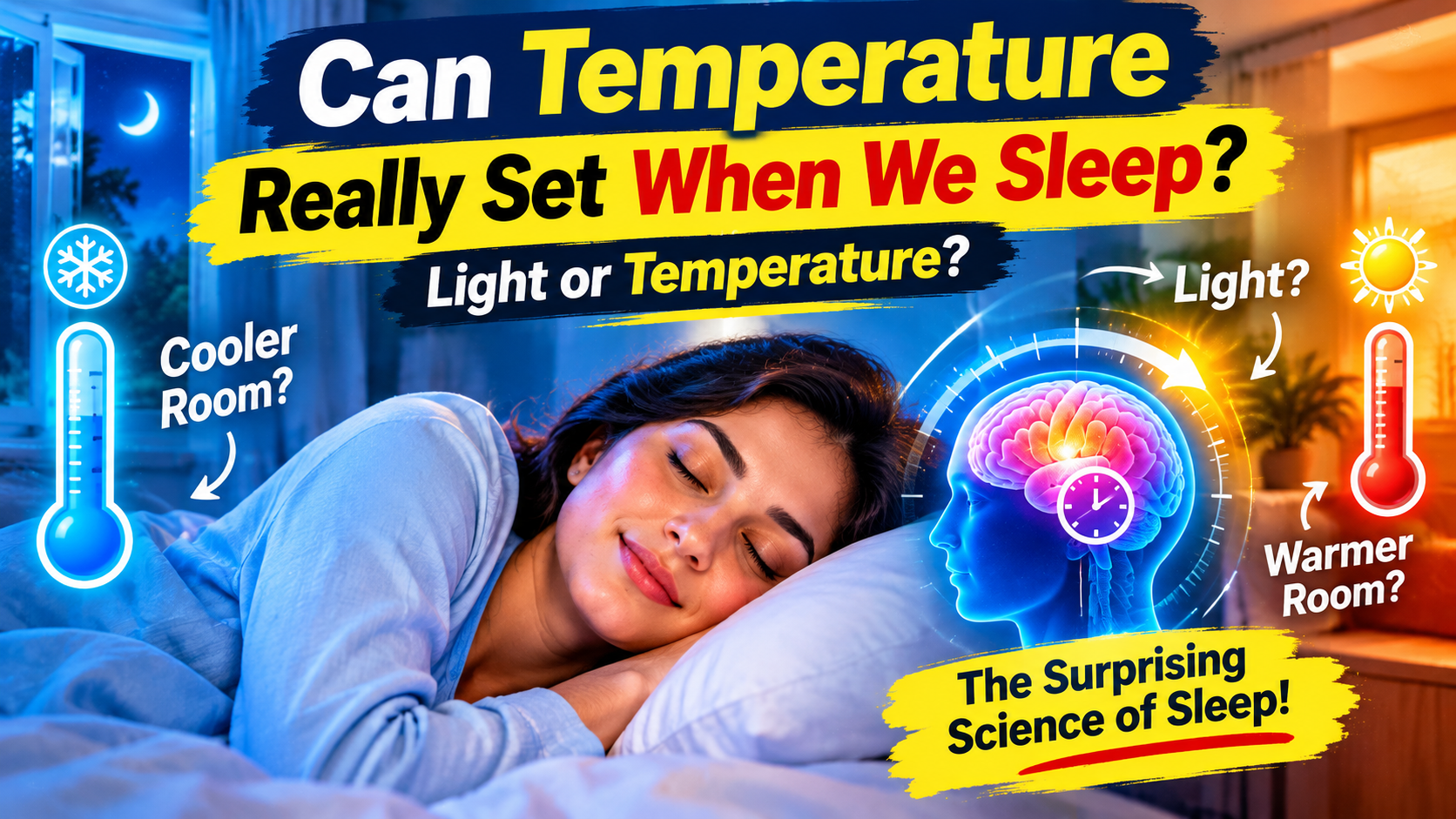
Is Your Bedroom Too Warm? How Temperature Affects Sleep (and Your Body Clock)
You’ve heard that light controls your sleep. But there’s a second signal most people ignore: temperature.
Ever fallen asleep faster in a cool room, or tossed and turned all night in a hot, stuffy one? That’s not just comfort. It’s biology.
Your body cools down to fall asleep
As bedtime approaches, your core body temperature starts to drop. Blood vessels near your skin widen, especially in your hands and feet, so heat can escape. For most people, the drop is about 1°C from the daytime high to the nighttime low.
Around the same time, your body raises melatonin, the hormone that helps you feel sleepy.
If the room is too hot, your body struggles to release heat. That can mean:
- Taking longer to fall asleep
- Waking up more often
- Restless, lighter sleep
- Feeling tired the next morning
Humidity makes it worse. Sweat can’t evaporate easily in humid air, so a warm room feels even hotter. This is a real issue in many Indian cities.
What traditional communities taught researchers
Anthropologist Gandhi Yetish noticed that people in non-industrial communities (the Tsimane in Bolivia, the Hadza in Tanzania, the San in Southern Africa) did not simply sleep by sunrise and sunset. Their sleep timing seemed closer to the natural rise and fall of temperature.
This doesn’t prove temperature controls sleep, since lifestyles differ in many ways. But it raised a big question: is temperature a hidden clock signal, like light?
What the studies suggest
- Fluctuating room temperature: In one study, participants slept in a room that cooled in the evening and warmed toward morning. They showed a higher marker of nighttime melatonin and felt more refreshed than people in a constant-temperature room.
- Body clock timing: A 2007 study found the body’s lowest temperature point shifted earlier under a natural-style temperature cycle. That point is a marker of circadian phase.
- Animals and cells: Temperature cycles can help set the body clocks of fruit flies and camels, and fluctuations influenced the clocks of human cells in the lab.
Is temperature the “new light”? Not yet
Chronobiologist Christian Cajochen notes that few experiments have directly tested this. Light is still the strongest, best-proven signal for your body clock. Temperature is probably a helper, not a replacement.
A hot room may also just ruin your sleep without shifting your clock at all. Scientists are still separating the two.
7 simple ways to sleep cooler tonight
- Keep the room comfortably cool. If you wake up sweaty, try lowering the temperature slightly.
- Improve airflow. A fan helps, but don’t aim it uncomfortably at your face.
- Choose breathable bedding. Light cotton beats heavy blankets that trap heat.
- Wear loose, breathable sleepwear.
- Avoid heating up right before bed. Skip heavy exercise and very hot rooms in the last hour.
- Open a window if the air is safe. Check outdoor heat, noise and pollution first.
- Watch your own response. If a cooler room helps you fall asleep faster and wake up fresher, that’s your answer.
Don’t go extreme. There’s no magic number, and freezing air can disrupt sleep too. If you shiver, it’s too cold.
Don’t forget light
Get bright daylight in the morning and dim the lights and screens at night. A perfectly cool room with bright light at midnight won’t help.
FAQ
What is the best bedroom temperature for sleep?
There’s no single perfect number. Age, humidity, bedding and climate all matter. Aim for comfortably cool, not hot or stuffy.
Does a hot room cause insomnia?
It can make falling and staying asleep harder. But insomnia has many causes, including stress, caffeine, screens and irregular schedules.
Does temperature reset your body clock?
Possibly, but it isn’t proven in humans. Light remains the main signal.
Is a fan or AC better for sleep?
Either can help. Choose what keeps you comfortable without making you shiver.
Final takeaway
Your body naturally cools as it prepares for sleep. A bedroom that supports that process is one of the easiest sleep upgrades you can make. Temperature isn’t the new light yet, but it may be another piece of the puzzle.
This article is for general information and is not medical advice. If you have long-term sleep problems, speak to a doctor.